

Mental Health Is Not a Punchline — It’s a Responsibility

Updated: Apr 9
By Dr. Leslie Bravo
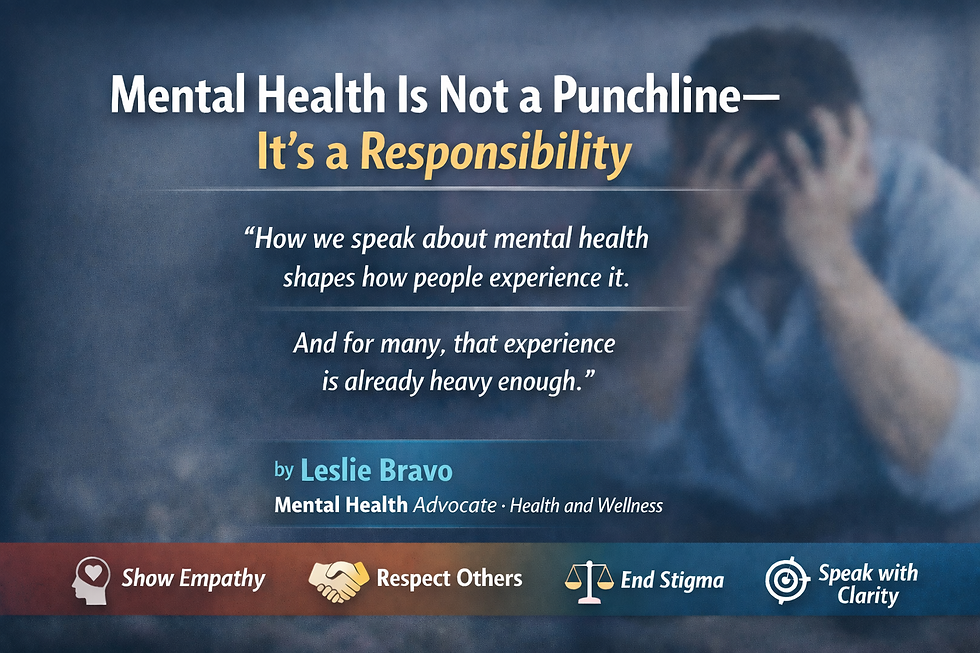
As conversations around mental health continue to grow, so does the need for clarity, responsibility, and discernment in how we engage with the topic.
Greater visibility is a step forward but visibility without thoughtful dialogue can quickly become counterproductive.
In both professional settings and everyday interactions, there has been a noticeable shift in how mental health is referenced. Serious conditions are often used casually, sometimes humorously, and at times as broad explanations for behaviors that are complex, multifactorial, or unrelated to mental illness altogether.
This is where we must pause.
Mental health is a clinical, social, and human reality that deserves accuracy, not assumption. While humor and lightness have a place in human connection, directing them toward individuals living with conditions such as schizophrenia, bipolar, multi-personality disorder or using diagnoses as shorthand for behavior, risks reinforcing stigma rather than reducing it.
And importantly, it can be deeply harmful to those who are actually living with these conditions, individuals who are already navigating stigma, misunderstanding, and barriers to care.
Equally important is the tendency to attribute a wide range of harmful or inappropriate behaviors solely to “mental health.” While mental health conditions can influence behavior, they do not universally explain it. Oversimplifying in this way can unintentionally blur important distinctions between accountability, environment, choice, and clinical need.
Thoughtful advocacy requires nuance.
It requires the ability to hold two truths at once:
That individuals living with mental health conditions deserve empathy, dignity, and access to care
And that not all behaviors should be labeled or excused under the umbrella of mental health
When these distinctions are lost, it not only impacts public understanding—it affects how communities respond, how systems are built, and whether individuals feel accurately seen or misunderstood.
In the work we do across communities, language matters. Tone matters. Intent matters.
Respectful, informed dialogue is not about limiting conversation—it is about elevating it.
If we are committed to advancing mental health as a core component of healthcare, then we must also commit to communicating about it with care, precision, and integrity.
Because how we speak about mental health shapes how people experience it.And for many, that experience is already heavy enough.
If you or anyone you know needs support contact: Recovery@soflo-wellness.com or Call: 561-501-1029
Emergency contacts: 911 or text 988


Comments